
Less than a week ago when everyone was convinced Twitter was about to die quietly in the small hours of the morning and the timeline was filled with heartfelt dedications to online friends, I posted a joke about what the demise of the platform would mean for the future of online engagement during academic conferences.
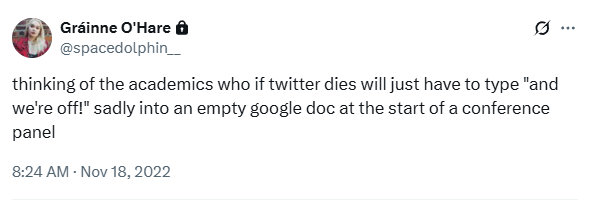
Some three hundred-odd people, mainly academics, liked and retweeted; I got a couple of earnest suggestions that the Google doc be a shared one to provide an alternative forum for commentary, and a few people getting sentimental in the mentions about what an important tool Twitter has been in fostering conference spirit and academic networks.
For those unfamiliar, the basic staples of conference live-tweeting are as follows:
- Obligatory photo of train interior (desk seat, takeaway coffee cup, laptop with research notes ambitiously open) captioned ‘On my way to Middle Wallop for #RaccoonSymposium2022!’
- Obligatory photo of university exterior (prospectus-worthy shot of red-brick building framed by lush and verdant trees; campus bins and hungover undergrads cropped strategically out) captioned ‘Here at sunny St Biftin’s for #HysteriaFest! Excited to give my paper on mental illness and lute music in the 1730s diaries of Lemuel Hootspringer!’
- Reverent nod to opening speeches: ‘Fascinating keynote by @ProfBartlettClamb on the ways in which our understanding of spleen malfunction has been shaped by modern discourse around fennel.’
- Energetic launch into the first panel: ‘And we’re off! First up, @DrHelenaSideorchard on dissecting marginalia in 19th-century roller-skating manuals.’
- Compulsive live commentary on all subsequent papers: ‘Kicking off the afternoon sessions, we have @HufftyMangle’s explosive paper, “Which Of The Mitford Sisters Was A Werewolf?”’
- Obligatory out-of-focus photos of each panel sat in front of a glaring PowerPoint screen, every member with a resting face of gradual dissociation, captioned ‘What a vibrant and insightful discussion on squid-farming in the early modern period, thanks to all the wonderful speakers!’
- Where applicable, quick nod to the scheduled entertainment segment before the wine reception: ‘What a way to close the day: a stunning monastic chant performance of Elizabeth Clapmantle’s 13th-century Latin verses.’
- Radio silence for twelve hours while everyone gets rat-arsed at the wine reception
- Repeat steps 3 through 8 for however many days of conference
- Self-satisfied sign-off on the train home: ‘And we’re done! A truly delightful few days at the Eighteenth-Century Conference of People, Places, and Things. Thanks everyone for such enlightening and invigorating discussion about so many interesting people, places, and things! Roll on next year!’
I’m always in two minds about conference live-tweeting. On one hand, it can at times seem performative and insincere, because no-one is ever going to post their real feelings about an academic event. You never click on a conference hashtag and see, ‘Finally out of this afternoon’s panel on depictions of armadillos in 19th-century western art, @DrMilesFlimsonby spoke 15 minutes over the allotted time so we’ve run late and now the only sandwiches left on the lunch buffet are egg mayo. Thanks for that! x x’ Conference tweeting is always a big online circle-jerk about what a privilege it was to take a five-hour Megabus and sit in a stuffy lecture theatre drinking the worst coffee you’ve had in your life, because everyone’s research is just so fabulous and interesting and an honour to witness.
On the other hand, I do concede that academia can be a very isolating space and consistently full of self-doubt, and it’s nice sometimes to get through a panic-fuelled presentation and see that someone has gone on Twitter and said generous and validating things about your work. I am personally terrible at conference live-tweeting, mainly because by the second panel I will invariably have run out of data and spent twenty minutes trying to connect to the campus Eduroam WiFi without any success. Twitter can be a fun platform to have during and after a conference, whether it’s realising how glaringly non-academic your handle looks listed next to your co-panellists (one day I’ll hopefully be *Doctor* Spacedolphin), or watching everyone roll out their thoughts and thank-yous like they’re signing each other’s shirts on an emotional last day of school. I enjoy the roulette rush of post-conference Twitter follows when you don’t yet know who only uses the website once a month for academia and who you’re about to see posting a forty-part thread of conspiracy theories about soup.
In closing: conference Twitter is like the phrase ‘the ways in which’; hackneyed boilerplate vocabulary that we often wish we could restate in a way that is fresh and original, but that, at the end of the day, we know does the job. I don’t know what we’ll do if Twitter does indeed flatline one of these days, because if you’re an academic at a conference and don’t tweet about it with all the expected hashtags and @s and ten thousand synonyms for ‘fascinating’, were you even there? (Don’t answer that; it was more a comment than a question.)
 good strong words
Leave a comment